When the system becomes the work
You may have a task list, a calendar, and several productivity apps, yet still avoid starting. Reordering tasks, checking messages, and refining the plan can feel productive while quietly replacing the work itself.
Procrastination does not always look like doing nothing. Sometimes it looks like very careful planning. The more fields a system asks you to maintain, the more resistance appears before the first step.
A task list is not a plan for the day
A list answers what you might do. A time block also answers when you will do it. That small difference removes repeated decisions: instead of choosing between the presentation, the email, and the bug every time you finish something, you give each priority a realistic place.
You do not need to schedule every minute. A few fixed points—such as a presentation from 9:00 to 10:30, email from 11:00 to 11:30, and development after lunch—can be enough to make starting easier.
- Choose two or three important outcomes.
- Give each one a concrete time.
- Leave open space for changes.
- Move a block when reality changes.
Make the first step smaller
“Finish the presentation” is large and vague. “Work on the first section for 45 minutes at 9:00” is specific enough to begin. The task tells you what; the block tells you when; the timer tells you how long you can ignore everything else.
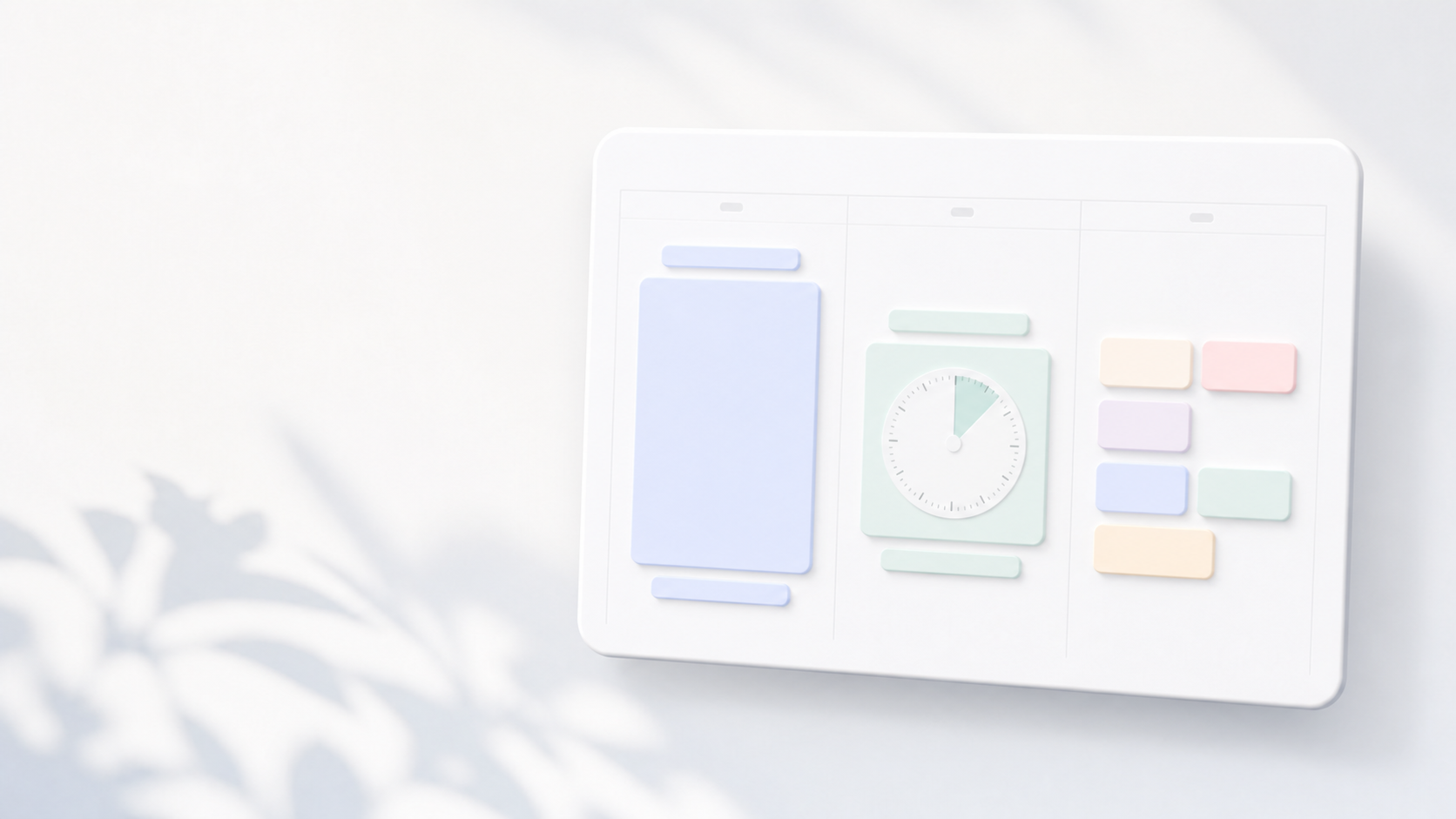
This is why a simple task list, time blocks, and a focus timer work well together. The goal is not to control the whole day. It is to remove the next decision when your attention is already needed elsewhere.
Do not plan eight perfect hours
A schedule packed with deep work, exercise, administration, reading, and a side project often creates an evening full of unfinished promises. Two genuinely focused blocks may be enough for an ordinary workday.
A plan is an orienting map, not a contract. Calls run long, tasks expand, and interruptions happen. Leave room for that instead of treating every open space as a failure to optimize.
A simple system for an ordinary day
Write down what you genuinely want to accomplish, choose the two or three most important items, give them concrete times, start a timer when the block begins, and move the plan when the day changes.
Paper works for the same reason: it asks nothing of you. A digital tool is useful when it keeps that simplicity while making it easy to move a block, extend it, or start a timer beside the task.
- Less categorizing.
- Less organizing.
- Less deciding.
- More starting.